
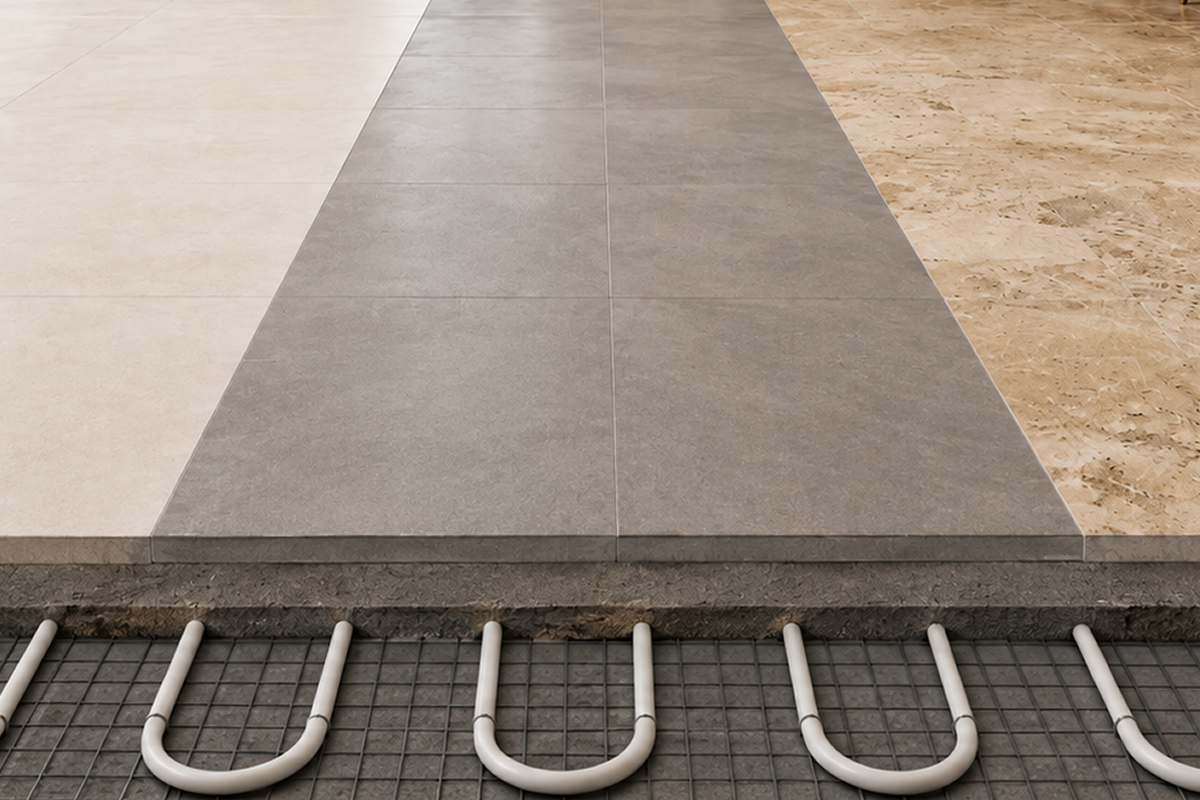
Choosing the right floor finish is one of the most important decisions when installing underfloor heating. While the heating system does the work beneath the surface, the floor covering determines how quickly, evenly and efficiently that warmth reaches the room.
For Australian homeowners renovating bathrooms, kitchens, living areas or entire homes, hard floor finishes are often the best match for underfloor heating. Ceramic tiles, porcelain tiles and natural stone all perform well because they conduct and retain heat better than many softer floor coverings.
However, they are not identical. Ceramic, porcelain and stone each respond differently to heat. Some warm up faster, some hold heat longer, and some require more careful installation.
This guide compares ceramic vs porcelain vs stone floors over underfloor heating, with a focus on heat emissivity, performance, comfort, energy efficiency and renovation suitability.
Why Floor Finish Matters With Underfloor Heating
Underfloor heating works by gently warming the floor surface, which then radiates heat upward into the room. Unlike ducted heating or split systems, which heat air directly, underfloor heating turns the floor into a large, low-temperature radiant heat source.
That means the floor covering becomes part of the heating system.
A good floor finish for underfloor heating should:
- Transfer heat efficiently
- Allow even surface temperatures
- Feel comfortable underfoot
- Handle repeated heating and cooling
- Remain dimensionally stable
- Suit the room’s moisture and usage conditions
Dense, hard materials generally perform best because they allow heat to move through them with minimal resistance. This is why tiles and stone are commonly recommended for both electric underfloor heating and hydronic underfloor heating systems.
What Is Heat Emissivity?
Heat emissivity refers to how effectively a surface emits radiant heat. In simple terms, it describes how well a material releases heat into the room once it has been warmed.
For homeowners, the practical question is:
How well does the floor surface transfer warmth from the heating system into the room?
Ceramic, porcelain and stone all have favourable thermal characteristics for underfloor heating. They are dense, stable and conductive compared with materials such as carpet, timber or thick vinyl. This helps the heating system operate efficiently and deliver a comfortable radiant warmth.
However, the total performance of a floor finish depends on more than emissivity alone. It also depends on:
- Tile or slab thickness
- Material density
- Thermal conductivity
- Surface finish
- Substrate preparation
- Adhesive selection
- Screed depth
- Heating system type
- Insulation beneath the heating layer
A highly conductive floor installed over a poorly insulated slab may still perform poorly. The full build-up matters.
Ceramic Tiles Over Underfloor Heating
Ceramic tiles are one of the most common floor finishes used with underfloor heating, especially in bathrooms, laundries and kitchens.
They are made from clay and other natural materials, fired at high temperatures. Compared with porcelain, ceramic tiles are usually slightly less dense and more porous, although this varies depending on the tile quality and glaze.
Heat Performance of Ceramic Tiles
Ceramic tiles generally offer excellent heat transfer. They warm up relatively quickly and distribute heat evenly across the floor surface when installed correctly.
Because many ceramic tiles are thinner than natural stone and some porcelain tiles, they can respond quickly to changes in thermostat settings. This makes them a practical option for rooms where heating is used intermittently, such as bathrooms.
For example, electric underfloor heating beneath ceramic bathroom tiles can be programmed to warm the floor before morning and evening use, delivering comfort without necessarily heating the room all day.
Advantages of Ceramic Tiles With Underfloor Heating
- Efficient at transferring heat
- Usually cost-effective
- Widely available in many styles
- Suitable for wet areas
- Compatible with electric and hydronic systems
- Relatively responsive to thermostat control
Limitations of Ceramic Tiles
Ceramic tiles can be slightly less dense than porcelain, which may affect durability in high-traffic areas. They may also be more prone to chipping depending on the tile body and glaze.
For underfloor heating, the main limitation is not usually the ceramic tile itself, but the installation quality. Movement, poor adhesive coverage or inadequate expansion joints can lead to cracking, particularly when the floor is exposed to heating and cooling cycles.
Best Uses for Ceramic Tiles
- Bathrooms
- Ensuites
- Laundries
- Powder rooms
- Kitchen splash-prone areas
- Smaller renovation zones
- Electric underfloor heating systems
Porcelain Tiles Over Underfloor Heating
Porcelain tiles are often considered a premium tile option for underfloor heating. They are made from refined clay and fired at higher temperatures than standard ceramic tiles, resulting in a denser, harder and less porous product.
This density gives porcelain excellent thermal performance and durability.
Heat Performance of Porcelain Tiles
Porcelain tiles conduct heat very effectively. Their density allows them to transfer warmth evenly across the floor surface, making them ideal for underfloor heating.
Porcelain may take slightly longer to warm up than thinner ceramic tiles if the tile is thicker or denser, but once warm, it provides a stable and consistent heat output. This makes porcelain particularly well suited to larger heated areas, open-plan living spaces and systems designed for regular use.
When paired with a hydronic heating system, porcelain can deliver excellent comfort and energy efficiency because the floor acts as a broad radiant surface.
Advantages of Porcelain Tiles With Underfloor Heating
- Highly conductive
- Dense and durable
- Low maintenance
- Moisture resistant
- Excellent for wet areas
- Suitable for high-traffic rooms
- Available in stone, concrete, terrazzo and timber-look finishes
Limitations of Porcelain Tiles
The main consideration with porcelain is installation. Because porcelain is dense and less porous, it requires appropriate adhesives and careful preparation. Large-format porcelain tiles also require excellent substrate flatness to avoid lipping and uneven heat distribution.
Thicker porcelain tiles may have a slower heat-up time, although this is usually not a problem in well-designed underfloor heating systems.
Best Uses for Porcelain Tiles
- Bathrooms and ensuites
- Kitchens
- Living areas
- Hallways
- Open-plan homes
- New builds
- Hydronic heated slabs
- High-use family homes
Natural Stone Floors Over Underfloor Heating
Natural stone is one of the most luxurious and thermally effective floor finishes for underfloor heating. Common options include marble, limestone, travertine, granite, slate and bluestone.
Stone has excellent heat retention. Once warmed, it can continue releasing heat for longer than many other floor finishes.
Heat Performance of Natural Stone
Natural stone typically has very strong thermal mass. This means it can absorb, store and slowly release heat.
In practical terms, stone floors may take longer to warm up than thinner ceramic tiles, especially if the stone is thick. However, once heated, they provide a deep, even and long-lasting warmth.
This makes stone particularly suitable for systems that run for longer periods, such as hydronic underfloor heating connected to an energy-efficient heat pump.
Advantages of Natural Stone With Underfloor Heating
- Excellent heat retention
- Strong radiant comfort
- Premium appearance
- Long service life
- Natural variation and texture
- Suitable for high-end renovations and architectural homes
Limitations of Natural Stone
Natural stone requires more care than ceramic or porcelain. Some stones are porous and need sealing. Others may be sensitive to staining, moisture, acidic cleaners or movement.
Stone thickness also matters. A thicker stone floor can increase heat-up time, which may affect responsiveness. This is not necessarily a problem, but it should be considered during system design.
Natural stone can also be more expensive to purchase and install. Substrate preparation, waterproofing, sealing and movement control are critical.
Best Uses for Natural Stone
- Luxury bathrooms
- Architectural homes
- Entry areas
- Living spaces
- Hydronic heated slabs
- Homes with passive solar design
- Projects where thermal mass is desirable
Ceramic vs Porcelain vs Stone: Performance Comparison
The best floor finish depends on how you want the room to perform.
Ceramic tiles usually provide quick heat response and good affordability. Porcelain offers excellent durability, conductivity and design flexibility. Natural stone provides superior heat retention and premium comfort, but requires more careful specification.
| Floor finish | Heat transfer | Heat retention | Warm-up speed | Durability | Best suited to |
|---|---|---|---|---|---|
| Ceramic tile | Very good | Good | Fast | Good | Bathrooms, laundries, smaller renovations |
| Porcelain tile | Excellent | Very good | Moderate to fast | Excellent | Bathrooms, kitchens, living areas, whole-home use |
| Natural stone | Excellent | Excellent | Moderate to slow | Very high, depending on stone | Luxury renovations, hydronic systems, architectural homes |
For many homeowners, porcelain is the most balanced option. It performs extremely well, is widely available, handles moisture, and suits both modern and traditional interiors.
Ceramic is often the most cost-effective and responsive choice.
Stone is the premium option for homeowners who want thermal mass, natural beauty and long-lasting radiant comfort.
Which Floor Finish Heats Up Fastest?
In general, thinner ceramic tiles tend to heat up fastest because they usually have less material for the heat to pass through.
However, this depends on the full floor build-up. A thin porcelain tile over a well-insulated electric heating mat may warm quickly, while a thick ceramic tile over an uninsulated slab may perform poorly.
Typical heat-up speed from fastest to slowest is:
- Ceramic tile
- Porcelain tile
- Natural stone
But this is a general guide, not a fixed rule.
The following factors can change the result:
- Tile thickness
- Screed thickness
- Whether insulation boards are used
- Slab temperature
- Heating cable or pipe spacing
- Thermostat programming
- Room size
- External wall and window performance
Which Floor Finish Holds Heat the Longest?
Natural stone usually holds heat the longest because of its thermal mass. Dense porcelain tiles also retain heat well, while ceramic tiles tend to cool a little faster.
Typical heat retention from highest to lowest is:
- Natural stone
- Porcelain tile
- Ceramic tile
This makes stone and porcelain particularly suitable for hydronic heating systems, which are often designed to run at low temperatures over longer periods.
Electric vs Hydronic Underfloor Heating: Does the Floor Finish Matter?
Ceramic, porcelain and stone can all work with both electric and hydronic underfloor heating, but the best choice may depend on the system type.
Electric Underfloor Heating
Electric underfloor heating is commonly used in renovations, especially bathrooms and smaller rooms. It is installed close to the floor surface, often beneath tiles.
For electric systems, responsive floor finishes are valuable. Ceramic and porcelain tiles are excellent because they transfer heat quickly and provide comfortable warm floors during scheduled times.
Hydronic Underfloor Heating
Hydronic underfloor heating circulates warm water through pipes beneath the floor. It is commonly used for larger areas, new builds, major renovations and whole-home heating.
Porcelain and natural stone are excellent matches for hydronic systems because they work well with steady, low-temperature radiant heat. Their ability to distribute and retain warmth supports comfort and efficiency.
When paired with an efficient heat pump, hydronic underfloor heating can provide comfortable heating with lower operating temperatures than many conventional heating systems.
The Role of Insulation Under Heated Floors
The floor finish is only one part of performance. Insulation beneath the heating system is just as important.
Without proper insulation, heat can escape downward into the slab or subfloor instead of rising into the room. This can increase running costs, slow heat-up times and reduce comfort.
In renovations, insulation boards may be used beneath electric underfloor heating to improve response times, particularly over concrete slabs.
In new builds, slab edge insulation and under-slab insulation can significantly improve hydronic heating performance.
Adhesives, Screeds and Movement Joints Matter
Underfloor heating creates gentle thermal movement in the floor system. This movement is normal, but it needs to be managed.
For tile and stone floors, the installation should use products compatible with heated floors. This may include flexible tile adhesives, appropriate levelling compounds and movement joints in the correct locations.
Poor installation can lead to:
- Cracked tiles
- Debonding
- Hollow-sounding areas
- Uneven heat distribution
- Grout cracking
- Waterproofing failures in wet areas
Which Floor Is Best for Bathrooms?
For bathrooms, ceramic and porcelain tiles are usually the most practical choices.
They are moisture resistant, easy to clean, compatible with waterproofing systems and available in a wide range of designs. They also work well with electric underfloor heating, which is common in bathroom renovations.
Porcelain is often the preferred option for premium bathrooms because it is dense, durable and low maintenance. Ceramic can be a more budget-friendly alternative while still offering excellent heating performance.
Natural stone can be beautiful in bathrooms, but it needs more maintenance. Some stone types require sealing and careful cleaning, especially in wet areas.
Best bathroom choice for most homeowners: porcelain tile.
Which Floor Is Best for Living Areas?
For living areas, porcelain and natural stone are both excellent options.
Porcelain is durable, easy to maintain and available in larger formats that suit open-plan interiors. It works well with both electric and hydronic heating, although hydronic is usually more suitable for larger living zones.
Natural stone is ideal where premium appearance and heat retention are priorities. It pairs especially well with hydronic underfloor heating in architectural homes and high-end renovations.
Best living area choice for most homeowners: porcelain tile for practicality, stone for premium thermal mass and design impact.
Which Floor Is Best for Whole-Home Underfloor Heating?
For whole-home underfloor heating, porcelain is often the most versatile option. It is hard-wearing, thermally efficient, moisture resistant and suitable for almost every room.
Natural stone can also be excellent, particularly in homes designed around thermal mass and hydronic heating. However, cost and maintenance need to be considered.
Ceramic tiles can work well throughout a home, but porcelain is usually preferred for high-traffic and large-format applications.
Best whole-home choice for most homeowners: porcelain tile.
Common Mistakes to Avoid
- Choosing very thick stone without considering heat-up time
- Installing heated floors without insulation
- Using adhesives not rated for heated floors
- Ignoring movement joints
- Installing large-format tiles over uneven substrates
- Not using a thermostat with a floor sensor
- Assuming all tiles perform the same
- Forgetting to coordinate heating layout with fixtures and cabinetry
Final Verdict: Ceramic, Porcelain or Stone?
Ceramic, porcelain and natural stone are all excellent floor finishes for underfloor heating. The best choice depends on your renovation goals, budget, room type and heating system.
Choose ceramic tiles if you want a cost-effective, responsive and reliable option for bathrooms, laundries or smaller renovation areas.
Choose porcelain tiles if you want the best all-round balance of heat performance, durability, design flexibility and low maintenance.
Choose natural stone if you want premium comfort, strong heat retention and a high-end architectural finish.
For most Australian homeowners renovating with underfloor heating, porcelain tiles are the safest and most versatile choice. They offer excellent heat transfer, strong durability and broad compatibility with both electric and hydronic systems.
However, when the system is properly designed, insulated and installed, all three materials can deliver the warm, comfortable and energy-efficient floor performance that underfloor heating is known for.
FAQs
Is porcelain better than ceramic for underfloor heating?
Porcelain is generally denser and more durable than ceramic, which makes it an excellent choice for underfloor heating. Ceramic still performs very well and may warm up quickly, especially in bathrooms and smaller rooms.
Does natural stone work with underfloor heating?
Yes. Natural stone is one of the best floor finishes for underfloor heating because it conducts and retains heat well. It may take longer to warm up, but it provides long-lasting radiant comfort once heated.
Which floor finish transfers heat best?
Porcelain and natural stone typically offer excellent heat transfer due to their density. Ceramic tiles also transfer heat very effectively, especially when thinner and installed close to the heating layer.
Do tiles crack with underfloor heating?
Tiles should not crack if the system is correctly designed and installed. Cracking is usually caused by poor substrate preparation, lack of movement joints, incorrect adhesive or structural movement.
Is underfloor heating suitable for bathroom tiles?
Yes. Underfloor heating is very well suited to bathroom tiles. Ceramic and porcelain tiles are especially popular because they are moisture resistant, comfortable, efficient and easy to clean.
What is the best flooring for hydronic underfloor heating?
Porcelain and natural stone are excellent choices for hydronic underfloor heating because they work well with steady, low-temperature radiant heat. Ceramic tiles are also suitable, particularly in smaller rooms.
What is the best flooring for electric underfloor heating?
Ceramic and porcelain tiles are ideal for electric underfloor heating, especially in bathrooms, ensuites and laundries. They transfer heat quickly and work well with programmable thermostats.